
The Skin You’re In
THE SKIN YOU’RE IN, AND THE AMAZING CELLS WITHIN
The average adult has around 22 pounds (or roughly 18 square feet) of skin. It’s thickest over the palms of the hands and soles of your feet, and thinnest over the eyelids and neck (which is why many people with sensitive skin notice inflammation and dryness first in those areas).
Hairdressers and other people working with chemicals often have chronically inflamed skin around their eyes, on their neck, and on their hands. Perfume allergies often first cause irritated inflamed skin around the eyes.
Your skin – the largest “organ” in your body – works 24/7 to protect the inside of your body from all sorts of external attacks. It has an amazing capacity to protect and heal itself.
Understanding Your Skin’s Microbiome
Your skin microbiome is a complex ecosystem of microorganisms, primarily bacteria, fungi, and viruses, that live on the skin’s surface and in the hair follicles. It plays a crucial role in maintaining skin health.
The skin microbiome is unique to each person, and its composition varies based on location, individual differences, and environmental factors.
A healthy skin microbiome is characterized by a diverse community of microorganisms, with a delicate balance between “good” and “bad” bacteria.
The skin microbiome helps maintain the skin’s barrier function by producing chemicals that reinforce tight junctions between skin cells, preventing water loss, and protecting the skin’s integrity.
The microbiome composition varies across different body sites (e.g., dry, moist, oily) due to factors like sebum (oil) production, humidity, and exposure to the environment.
Genetic factors, hygiene practices, diet, and even clothing can influence the composition of an individual’s skin microbiome.
Disruptions to the skin microbiome, or “dysbiosis,” can be associated with various skin conditions, including acne, eczema, and other inflammatory skin diseases.
Our skin microbiome has many roles:
*Communication with our internal immune system
*Fighting off infection
*Reducing inflammation
* Supporting the skin’s protective barrier function.
What else affects the skin Microbiome?
- Exercise- due to sweating, changes in skin temperature, resulting pH changes and immune function changes.
- Environmental factors: seasonal changes, climate (humidity vs dry air), treatment with medications that can affect our skin’s ecosystem (antibiotics, chemotherapy, anti-ulcer drugs, and especially the long-term use of cortisone-containing creams), and skin care products that are poorly made, irritating, or have a high pH.
- Diets high in sugar and processed foods have also been shown to damage the skin’s ecosystem by causing inflammation and increased activity of harmful microorganisms.
The skin microbiome plays crucial roles in maintaining skin health, supporting immune function, and protecting against disease.
It is increasingly being recognized that by supporting our skin’s natural ecosystem, and by avoiding products or activities that damage it, then our skin health will be much improved.
Modern management of skin conditions (not diseases) like aging, pigmentation, acne, rosacea, wrinkles and general sun damage, focus more and more on nurturing, not nuking, our fragile skin ecosystem. With relatively simple treatments, dramatic improvements can occur.
The microbiome helps maintain optimal pH (acidity) of our skin, which allows the skin barrier to function best.
Here is a bit more about pH and our skin-this is an important and often overlooked factor in skin health and disease.
The skin’s natural pH is slightly acidic, typically ranging between 4.5 and 5.5, with an average of around 5.5.
A thin, protective film covers our skin’s surface called the acid mantle, and the acidity is caused by a mixture of chemicals and bacteria on our skin- oils, sweat, dead skin cells, and various micro-organisms.
The acidic pH inhibits growth of harmful micro-organisms, maintains the skin barrier, reduces inflammation /irritation, and allows natural chemical processes to occur on our skin. Hydration is also better with an optimal skin pH.
Many things cause our skin pH to be disrupted:
*Strong soaps (are usually too alkaline)
*Washing our skin too much- this strips essential natural oils from our skin
*Some skin care products have a high pH (above 6 is not ideal)
*Our skin tends to get more alkaline (higher pH) as we get older
* Solar radiation harms our skin’s microorganisms, which reduces their ability to maintain a healthy skin pH
It is interesting that normal skin pH varies, depending on where the skin is- for example, skin under our arms, and on the soles of our feet, is normally at a pH of about 7.0
The best ways to maintain a healthy skin pH are:
*Use low pH cleansers (under 5.5)
*Use toners after cleansing
*Don’t cleanse more than twice a day
*Use warm water when washing- hot water will dehydrate your skin and remove essential oils as well
*Avoid perfumed skin care products, as the perfume is often detrimental to your skin’s natural bacterial balance
* Use a moisturizer regularly- this will support the skin barrier function
When your skin pH is too high (alkaline) you may notice dry irritated flaky skin with frequent acne breakouts.
When your skin pH is too low (acidic) you may notice a stinging burning sensation, that your skin is over-reactive and has a dry flaky appearance.
These ingredients tend to balance your skin pH and return it to normal ideal levels: lactic acid, glycolic acid, niacinamide and ceramides (bio-identical fats).
Health and Disease Relationships
When the healthy microbiome is damaged or disrupted, it is increasingly being recognized that skin diseases formerly thought to be “no known cause” or “inherited,” meaning there’s not much you can do about it, when in fact, by correcting your damaged skin ecosystem, dramatic improvements can occur. Common conditions associated with microbiome imbalances include:
- Atopic dermatitis (eczema)
- Acne vulgaris
- Psoriasis
- Seborrheic dermatitis
- Rosacea
These conditions often involve overgrowth of certain microorganisms or loss of beneficial species that normally help maintain skin health- for example, demodex in Rosacea, or Malassezia yeasts in Seborrhoeic Dermatitis.
The Two Sensations of Your Life
“There are two sensations of skin you will always remember in your lifetime:
The first time you fall in love – and that person holds your hand,
and the first time your child grasps your finger.
In each of those times, you are sealed to the other for eternity.”
~Alyson Richman, author of The Lost Wife
So why do people go to extremes to look younger as they age?
A youthful, healthy complexion has a huge impact on how you perceive the world, and on how the world perceives you. Whereas blotchy, wrinkled, dry skin doesn’t make anyone feel good.
Unfortunately, people do judge a book by its cover, and that’s not just socially. Attractive, confident people tend to be happier and more successful, and are more likely to be selected first in job interviews.
I’m not intending the following to be a lecture on anatomy. But I think it’s important to know how the important cells in your body work, and how damaged cells can affect your skin’s appearance.
Your Skin’s Crucial Layers, and How They Function
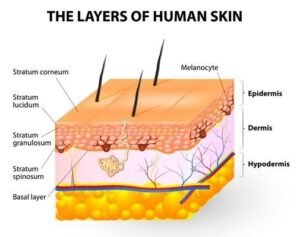
Your skin consists of three layers: the epidermis, dermis, and hypodermis.
Epidermis
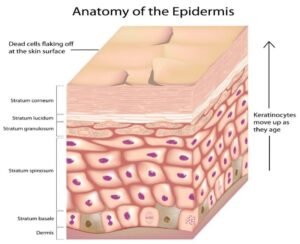
The epidermis is the outer layer of skin, and contains five layers, varying in thickness from 0.05mm on the eyelids to 1.5 mm on the palms of your hands and the soles of your feet.
The epidermis contains melanocytes that produce melanin, the dark pigment that gives your skin a tan (and slight protection from solar induced damage – more about this soon). The major cell in the epidermis is the keratinocyte which I describe below.
Dermis
Below the epidermis is the dermis (which on average is about 2mm – or .078 inches – thick) that provides structure, elasticity, and strength to the skin.
Insufficient water in the dermis reduces the ability of the skin cells to renew or repair, and wounds heal poorly.
The dermis contains a network of structural proteins (collagen and elastin), blood, and lymph vessels. Blood vessels constrict or dilate to conserve or release heat. They aid in the body’s immune function, and provide oxygen and nutrients to the lower layers of the epidermis.
These blood vessels don’t extend beyond the dermis. The cells in the upper layers of the epidermis die because they don’t receive oxygen and nutrients. This is important, especially with skin cancers.
If a skin cancer grows down into the dermis, it can grow into the blood and lymph vessels and be carried throughout the body.
Hypodermis
The hypodermis – the deepest layer of your skin – contains fat cells that provide insulation and padding, as well as providing storage for nutrients and energy.
Your Amazing Skin Cells: Nurture Them, Don’t Damage Them!
Fibroblasts
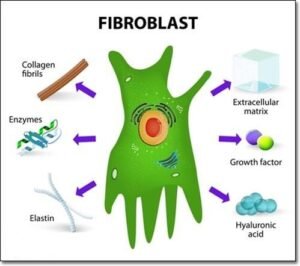
Fibroblasts are the building blocks of the skin. They occur in the dermis and produce the supporting proteins (collagen and elastin), and the mixture of sugars and hyaluronic acid that forms a gel surrounding the cells. Collagen and elastin give your skin its strength and elasticity – which gradually reduces as you age.
These essential cells require vitamin C to produce collagen, and vitamin A, which controls cell growth and division. Both vitamins are damaged by direct exposure to sunlight.
If there’s insufficient water in the dermis, wounds heal poorly due to the inability of skin cells to renew or repair.
Langerhans Cells
These cells are a central part of the skin’s immune system. They attach to foreign chemicals or microorganisms and transport them to lymph glands, where these foreign substances are attacked and destroyed by other specialized immune cells. Numbers and effectiveness of Langerhans cells reduce with age, and with exposure to too much solar radiation.
Keratinocytes
Keratinocytes are the skin cells that over 10 to 15 days move up through the skin layers from the basal layer (“stratum basale”) to the stratum corneum. 95% of the cells of the epidermis are keratinocytes.
As a keratinocyte moves upwards, it becomes flatter and harder due to its producing keratin, a protein that exists in everything from skin to hair, and to horns in animals.
Keratinocytes form part of the skin’s barrier mechanism by stopping chemicals and microorganisms from entering the skin and by slowing down the evaporation of water, which keeps the skin hydrated.
As they get closer to the skin’s surface, keratinocytes also start producing fats (cholesterol, triglycerides, and free fatty acids) that form a mortar between the keratinocytes, adding to the skin’s barrier mechanism.
These fats are important because they prevent water loss from the skin and protect it from damage by environmental factors, such as chemicals, microorganisms, and solar radiation. Too much washing of your skin with soap removes a lot of these fats and oils, and is not good for your skin.
Keratinocytes are regularly shed from the skin surface. This loosening is caused by enzymes that need water to function effectively.
So, if the skin is damaged or dehydrated, the regular shedding of the keratinocytes is compromised, and the dead keratinocytes collect as lumps or flakes on the skin surface – a common occurrence in aging and sun-damaged skin, which tends to be drier, with keratinocyte production being less regular.
Another important function of the keratinocyte is the production of water-retaining proteins that become part of the skin’s Natural Moisturizing Factor.
Keratinocytes communicate with melanocytes. As the keratinocytes get closer to the skin’s surface (and to solar radiation), they send a message back to the melanocytes saying, “I need sun protection, send up more melanin.”

Melanocytes
Melanocytes also occur at the basal layer. In an attempt to protect the skin from sun damage, they produce the dark pigment melanin in response to solar radiation.
Melanocytes have long tentacles through which they transfer melanin granules via melanosomes to surrounding cells, which are mainly but not only keratinocytes.
Once the melanin has been transferred to the keratinocyte, it sits above the cell’s nucleus like an umbrella to protect the DNA in the cell. But prolonged sun exposure without protection can be too much for the skin’s natural defences. If a cell’s DNA is damaged, some cells can become cancerous (“malignant melanoma”).
Melanin absorbs sunlight, which is why a naturally light-skinned, tanned person can stay in the sun up to four times longer than someone with no tan before they get burned. An African American’s natural skin color provides an SPF of about 12, compared to sunscreens that provide an SPF of 30 or 50.
I discuss sunscreens, tans, and SPF in the article about Sunscreens.
SPF is not a measure of how long you can stay out of the sun when using a sunscreen, compared to not using one.
SPF is actually a ratio of the amount of UV radiation that would cause sunburn with sunscreen, divided by the amount of UV radiation that would cause you to burn without using sunscreen.
So SPF is actually the percentage of sunburn-causing radiation that still gets through the sunscreen onto your skin.
This means, for example, an SPF of 25 allows 1/25th or 4% of sunburning rays through, compared to an SPF of 50, which allows 1/50th or 2%, while blocking 98% of the sun’s rays.
The best protection is provided by a “broad spectrum” (UVA and UVB blocking) sunscreen, and no matter the SPF value, is has to be re-applied every 2 hours if you are spending time outside.
Speaking of “pretend tans”, fake tans give you no protection from the sun unless they contain a sunscreen as well.
Acidic compounds affect the darkness of melanin, which is why some superficial peels like salicylic acid or lactic acid can have a skin-lightening effect.
Sometimes melanin is taken up by other cells in the base of the skin. These cells don’t migrate to the surface and flake off like the keratinocytes do, because of the depth of the pigment, which is why some pigmentation problems are very resistant to treatment.
Prolonged sun exposure causes this to happen (which you’ll often see in older people who have dark brown blotches on their arms, hands, and face). These dark brown spots are called solar lentigos.
Fighting Off Intruders: Your Skin’s Natural Defences
Your skin is the first part of your body that encounters factors in the environment that can damage your skin, such as solar radiation, attack by microorganisms, chemical irritation from cosmetics and cleansers, soaps, and dry air, to name a few.
Your skin’s natural secretions, such as sweat and sebum, fats, and natural moisturizing factor, form a layer on the skin’s surface called the acid mantle that contains natural, healthy bacteria (it’s an ecosystem in delicate balance).
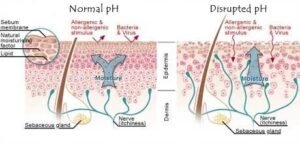
Image from www.fulomskin.com
An intact acid mantle, where the skin’s pH or acidity level is about 5.5, is the skin’s first line of defence. A healthy acid mantle also reduces the evaporation of too much water from the skin.
If the acid mantle becomes damaged, an overgrowth of harmful bacteria occurs. So, it’s a mistake to use harsh soaps or chemicals to try to sterilize your skin. You’ll kill off the good germs, which will allow the bad ones to flourish like weeds in a garden.
There are approximately 1,000 species of beneficial bacteria and yeasts that live in a delicate balance on your skin. They’re essential for fighting off harmful bacteria by excreting substances that kill the foreign germs.
One of the substances produced by these healthy microorganisms is azelaic acid. Azelaic acid is actually used in acne treatments because it kills harmful bacteria associated with acne, as well as having strong anti-inflammatory effects.
It’s good to have clean skin. But sterile skin is dangerous, as well as being impossible to achieve. Too much harsh “cleaning” will cause the loss of protection from good bacteria, and you’ll begin to get problems like acne, eczema, cold sores, and dermatitis, due to overgrowth of bad bacteria!
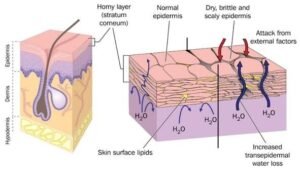
Some Notes About Skin Function and Conditions
Poor or inappropriate fluid intake (i.e. alcohol, tea, coffee) causes reduced water content in the dermis, which affects the normal skin functions, including the skin barrier and acid mantle. They are all diuretics, meaning you excrete in your urine more fluid than you drank as coffee, tea or alcohol.
Puberty with increased androgen production causes enlarged sebaceous (oil-producing) glands, with blockage of hair follicles and increased production of oils and fatty acids, which can cause inflammation of oily skin.
Menopause causes a decrease in both estrogen and androgen production (though some women experience a relatively increased androgen effect as their estrogen levels (the amount in the body tissues) drop off. The overall reduced estrogen level causes thinning of the epidermis. There’s also a reduction in production of collagen and elastin, resulting in wrinkles developing, first around the corners of the mouth, eyes, and along the upper lip.
Solar Radiation stimulates keratinocyte cell production, which can block the sebaceous glands. These keratinocytes are not healthy, and can develop into skin cancers.
Sunlight also damages collagen and elastin, as well as causing fibroblasts to age more quickly, reducing the production of elastin and collagen.
This causes abnormal elastin in the reticular layer of the dermis, which forms pads around the sides of wrinkles. You will also see thickened wrinkles especially in the back of the neck in men for these reasons.
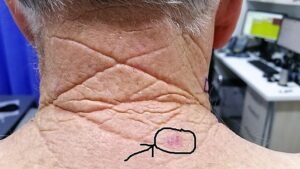
This man has typical sun induced deep wrinkles on the back of his neck. The pink/red lump on the right side (circled) is a form of skin cancer (squamous cell carcinoma)
Production of elastin starts to decrease in women by their mid-20s, and excess solar exposure makes it happen more quickly.
If you look closely at women in their mid-20s (especially those who’ve had a lot of solar exposure) you’ll already see signs of aging. Fine lines appearing above their upper lip and at the corner of their eyes is often combined with irregular areas of hyperpigmentation (brown or red areas/patches), all of which are signs of breakdown of elastin and collagen, and skin inflammation.
This same process occurs in men at a later age. Men age differently as their skin tends to be thicker, tighter, and oilier than that of women of the same age.
Time Waits for No One: Your Skin’s Life Story
Fashion designer Coco Chanel said, “Don’t spend time banging on a wall, hoping to transform it into a door.” I think she meant it’s a waste of time trying to change something you can’t change.
In this case, it’s your aging and sun-damaged skin. She might have had a different opinion if she’d had the new skin care products available to her then that we have today.
You can’t magically turn a wall into a door. But you can make the wall look more attractive by removing mould and old paint, restoring the mortar, and even replacing tired, old, cracked bricks with new ones.
That’s just what these skin care products do. They don’t reverse time or your age, but they improve your skin and make it look younger and healthier for a lot longer, by encouraging the growth of new cells and reviving tired, old cells.
Can You Turn Back the Effects of Aging and Time?
I’ve heard people say, “I don’t care what I look like. I’ll just grow old gracefully like nature intended”, as if they’ll look fine just by thinking positively. But after a few years, their thinking changes when they look in the mirror and don’t like what they see.
People and their skin don’t always age gracefully, and that’s where these new skin care products can make such a difference. They can make your skin look younger and healthier, for longer, as you will see in the section Case Studies-Real People, Real Results.
Your Skin is the Mirror of Your Soul
Your skin is the membrane between your inside and your outside. It’s your protective mantle that tells the world who and what you are, and in many cases where you’ve been and what you’ve been doing. It’s like a t-shirt that advertises your health to whoever is looking at you.
Someone who’s 30 years old with severely damaged skin can look 50 years old or older. And the reverse is possible: someone who looks 50 can look 40 and possibly even younger.
From Baby Fat to Wrinkles
Everyone knows their skin changes as they age. But these changes might not be welcome. The good news is these changes can be minimized and greatly improved by having a healthy lifestyle and a good diet. And by using the new skin care approach: Corneotherapy.
Your skin looks best during two crucial periods of your life:
First as an infant when you’re cared for and crooned over, and people love touching your peachy-perfect skin. Then when you want to attract a partner in your teens and twenties, just when your hormones are going crazy!
This is what happens to your skin as it ages:
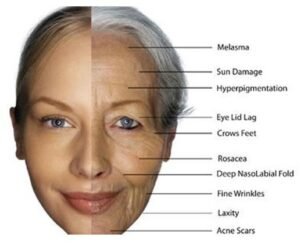
Baby/young child: You’re adorable, and everyone wants to cuddle you and tweak your chubby cheeks. You don’t have to put anything on your new skin as it’s lovely and smooth, fresh, vibrant and glowing.
Early 20s: Your skin is still young and fresh, so this is the time to start taking care of it. Genetically you’re programmed to have your best skin at this age to attract a partner. Like having nice teeth and a confident smile, good skin makes you look and feel more attractive.
20s to early 30s: Your skin begins to lose the ‘bloom’ of youth. It may show signs of dryness if you’ve been exposed to too much sun, and/or you didn’t nurture it. The production of natural skin fats begins to decline. For women (I realize this is unfair) there are also hormonal changes that cause your skin to be more sensitive and dry during and immediately after your menstrual cycle
Mid to late 30s: If you have dry skin, you might notice fine lines that occur in oily skin at a later stage. At the same time, tiny blood vessels (broken capillaries) can appear around the cheeks and nose, and your skin begins to lose its barrier function.
40s: Your skin begins to lose its tone, strength, and elasticity. Wrinkles and bags begin to form around the eyes and on the upper lip. Your skin becomes dryer, which leaves it loose and flabby. For some women, hormonal changes also cause “middle-aged acne”.
Older: Your skin is fragile, and shows everything more. It’s lost its elasticity, and flushes easily. Pores become enlarged, and lines deepen around your eyes, mouth and forehead. Older complexions tend to be dull and dry. There are often broken capillaries on the cheeks and nose, with brown blotches over the face and arms.
I hope you enjoyed your tour around your skin as much as I did!
Your skin is like a painting, your picture to the world.





Leave a Reply