Case Studies
Case Study: The 45-Year Old Australian Gardener
Case Studies
The 45-Year Old Australian Gardener
A common problem I see in men’s skin is chronic sun damage with dehydration that appears as dry, inflamed, leathery skin with a few brown blotches. In other words, premature aging is seen in both men and women.
This 45-year old Australian gardener gets a lot of solar exposure when he works outside. He wears a hat when he remembers, but otherwise uses no other sun protection.
He washes his face with soap he buys from the local supermarket that probably contains harsh chemicals. Consequently, he has all the features of dry, damaged, blemished, aging skin with diffuse redness across his cheeks and nose.
His vicious cycle of washing his face with harsh soap…
- removes oils from the skin and damages the water barrier. He thinks his skin feels “clean and fresh,” when in fact it’s lost its moisture.
- causes dry, inflamed skin that’s more easily damaged by sun, wind, and dirt.
- Takes the oils from his hands, making the skin dry and rough, and easily damaged due to the damaged skin barrier.
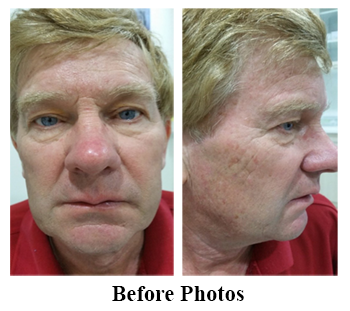
You might think he doesn’t look too bad. You might even think your skin looks similar. You wash regularly and feel healthy, so you’re happy enough with it.
But look closer at his side view where you can see deep wrinkles and a few areas of hyperpigmentation, and his skin looks inflamed, dry and tired:
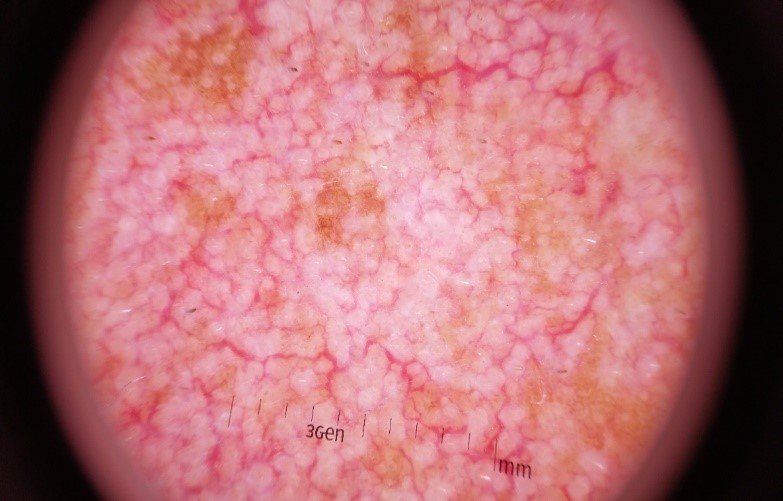
Now look at the 20 x magnification photo of his cheek that reveals significant inflammation with enlarged blood vessels (giving him that red-faced look) and scattered hyperpigmentation (brown spots):
I advised him about an appropriate broad-spectrum sunscreen that will protect him from ultraviolet but not infrared radiation.
For his occupation as a gardener, he needs something to clean his skin without drying it out and making it more susceptible to further damage.
I advised him to use CeraVe Hydrating Cleanser which contains three essential ceramides, hyaluronic acid, and vitamin B5. These work together to restore the skin’s barrier, retain moisture, and make his skin more resistant to damage from the sun, dry winds and dirt. It is a good affordable cleanser he can use every day for his whole body.
I gave him a cream containing vitamins A and C with ceramides and azelaic acid, in a bio-identical base cream containing hydrogenated phosphatidylcholine, shea butter and glycerine.
This base cream has natural anti-inflammatory effects, adding to those of the antioxidants.
Vitamins A and C are potent antioxidants that can reverse a lot of sun damage and premature aging, as well as offer protection against further damage from ultraviolet and infrared radiation.
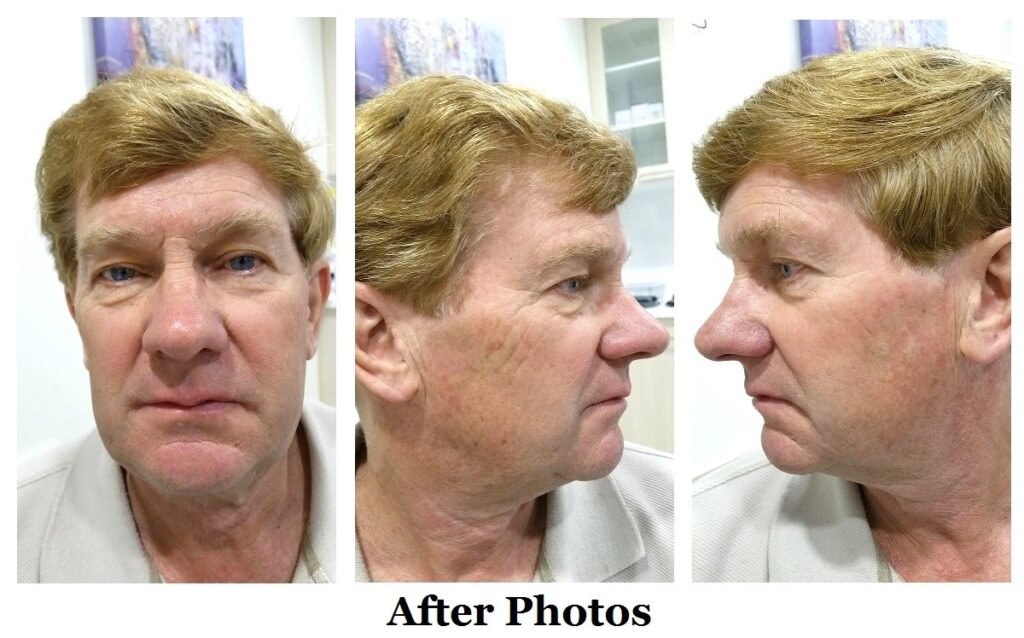
These follow-up photos taken two months later show significant improvement with his skin looking smoother, more “alive” and less inflamed.
The improvement is even more marked when looking at his face with 20 x magnification- his brown blotchy pigmentation has virtually disappeared and the prominent enlarged veins on his face are much less obvious.
It should be noted that despite continuing to work outside during the middle of summer in Tasmania, which has one of the highest UV ratings in the world, his skin has improved dramatically with the treatment I provided. I expect his improvement to continue over the coming months.
A common problem I see in men’s skin is chronic sun damage with dehydration that appears as dry, inflamed, leathery skin with a few brown blotches. In other words, premature aging is seen in both men and women.
This 45-year old Australian gardener gets a lot of solar exposure when he works outside. He wears a hat when he remembers, but otherwise uses no other sun protection.
He washes his face with soap he buys from the local supermarket that probably contains harsh chemicals. Consequently, he has all the features of dry, damaged, blemished, aging skin with diffuse redness across his cheeks and nose.
His vicious cycle of washing his face with harsh soap…
- removes oils from the skin and damages the water barrier. He thinks his skin feels “clean and fresh,” when in fact it’s lost its moisture.
- causes dry, inflamed skin that’s more easily damaged by sun, wind, and dirt.
- Takes the oils from his hands, making the skin dry and rough, and easily damaged due to the damaged skin barrier.
You might think he doesn’t look too bad. You might even think your skin looks similar. You wash regularly and feel healthy, so you’re happy enough with it.
But look closer at his side view where you can see deep wrinkles and a few areas of hyperpigmentation, and his skin looks inflamed, dry and tired:
Now look at the 20 x magnification photo of his cheek that reveals significant inflammation with enlarged blood vessels (giving him that red-faced look) and scattered hyperpigmentation (brown spots):
I advised him about an appropriate broad-spectrum sunscreen that will protect him from ultraviolet but not infrared radiation.
For his occupation as a gardener, he needs something to clean his skin without drying it out and making it more susceptible to further damage.
I advised him to use CeraVe Hydrating Cleanser which contains three essential ceramides, hyaluronic acid, and vitamin B5. These work together to restore the skin’s barrier, retain moisture, and make his skin more resistant to damage from the sun, dry winds and dirt. It is a good affordable cleanser he can use every day for his whole body.
I gave him a cream containing vitamins A and C with ceramides and azelaic acid, in a bio-identical base cream containing hydrogenated phosphatidylcholine, shea butter and glycerine.
This base cream has natural anti-inflammatory effects, adding to those of the antioxidants.
Vitamins A and C are potent antioxidants that can reverse a lot of sun damage and premature aging, as well as offer protection against further damage from ultraviolet and infrared radiation.
These follow-up photos taken two months later show significant improvement with his skin looking smoother, more “alive” and less inflamed.
The improvement is even more marked when looking at his face with 20 x magnification- his brown blotchy pigmentation has virtually disappeared and the prominent enlarged veins on his face are much less obvious.
It should be noted that despite continuing to work outside during the middle of summer in Tasmania, which has one of the highest UV ratings in the world, his skin has improved dramatically with the treatment I provided. I expect his improvement to continue over the coming months.